
It’s been a while since AI chatbots, and now AI agents, became part of our lives. We can clearly see their impact, even in our everyday lives. As Elon Musk said on 23 July, “Let’s enjoy the ride.” If you’re someone who enjoys testing new technology or learning about the latest innovations, we believe you should enjoy the ride too.
As an SEO expert, I’ll explain what’s happening in the SEO world right now and how we at Red Herring Digital (RHD) are helping our clients continue to grow their revenue and conversions despite all these changes.
Are you worried about AI?
Do you think AI agents can do everything for you?
Are you wondering how you should adapt to these changes?
Are you worried about AI taking over your job?
If you’re already working with RHD, you know we’re not afraid of AI. We build long-term strategies tailored to each client rather than chasing short-term trends. But let’s look at what’s changed across the industry and what we’re doing as a digital marketing agency that offers SEO and the services that now support it, including AEO (Answer Engine Optimisation) and GEO (Generative Engine Optimisation).
What has changed in SEO over the past 10 months?
You already know the SEO landscape has changed. Your first thought might be, “People aren’t using Google anymore. They’re asking AI chatbots instead, so SEO is dead.”
That’s a very beginner-level way of looking at it. We’ve discussed this before, but if you’re reading this, we assume you’re looking for a complete and accurate answer from an SEO expert.
Here’s my answer.
As user behaviour has changed, brands need to be visible across every platform that matters to their industry and business goals. Yes, Google’s rankings and the traditional blue links have lost some of their importance, but have they really lost all of their value? Or do they still play a critical role?
To understand today’s search landscape, you first need to understand how search engines and AI models work. Don’t worry, I’m not trying to turn you into an SEO expert, and we’ll cover those topics in separate posts in the future. I’m simply trying to show you the bigger picture.
All online platforms are connected. AI models scan information from across the web to generate the best possible answers based on how they have been trained and the sources they trust. At Red Herring Digital, we understand how these systems work, and our goal is to ensure our clients are visible wherever their customers are searching, whether that’s Google Search, AI assistants, social platforms, maps, marketplaces, or anywhere else relevant to their business.
Is it easy? No. But we’re a bunch of digital geeks who are constantly learning and adapting to stay ahead.
What was SEO like before?
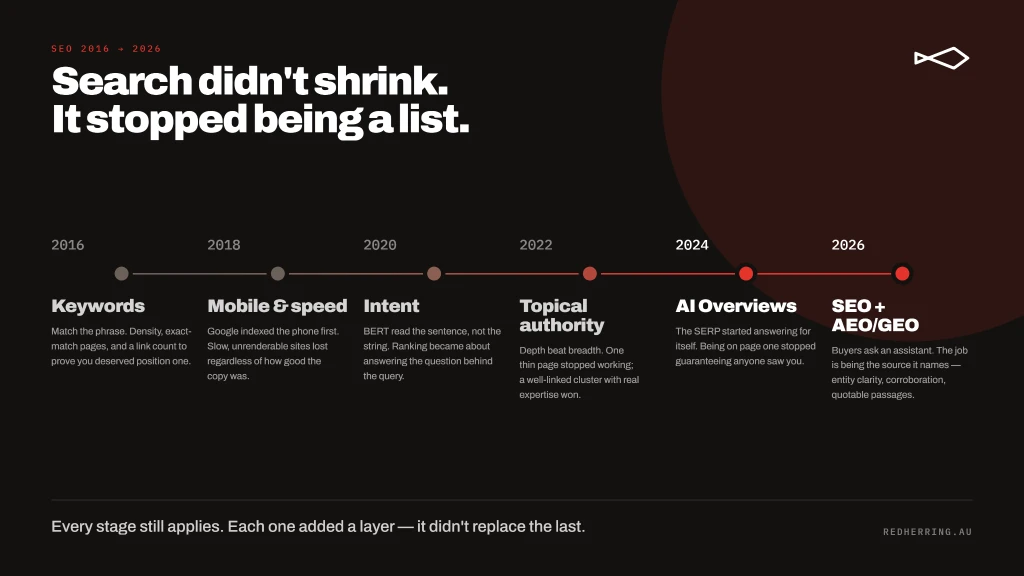
Traditional SEO strategies before the rise of AI were built around finding the keywords most relevant to a business with the highest search volume. Every step of the process aimed to attract highly relevant organic traffic, guide those users towards conversion, and provide a great user experience along the way. Ranking number one for your target keywords was a major objective because it increased your visibility and gave you the best chance of attracting clicks.
To achieve that, we used many different tools and strategies. The process usually started with a website audit (if the business already had a website), competitor analysis, keyword research, technical SEO, content planning, and many other activities that all worked together towards the same goal.
When social media entered the picture, it took time to understand how organic social performance could be measured accurately and how websites and social platforms should work together, even though their audiences were sometimes different. As a result, SEO specialists and social media teams began working much more closely together because they were representing the same brand, usually following the same brand guidelines. More importantly, the data showed that each channel influenced the performance of the others.
The same thing happened with YouTube and other social media platforms. However, because SEO existed before these platforms became mainstream, websites naturally became the centre of most digital marketing strategies. SEO was already well established when websites were little more than a few pages with short blog posts. As new channels emerged, they were gradually integrated into the overall SEO strategy rather than replacing it.
Long story short, the overall mindset remained the same. The goal was to drive organic traffic from Google and other search engines. When someone searched for your target keywords, you wanted your brand to appear first because that gave you the highest chance of being seen.
And let’s be honest, SEO experts have always been the type of people who check every result on the first page before buying anything. Even back then, users were the ones who ultimately decided whether they trusted a website or not. Google could rank you highly, but it was always the user who made the final decision.
What are the metrics in traditional SEO?
The exact KPIs vary depending on the client’s goals, industry, and business model. For example, an eCommerce business may focus on revenue and product sales, while a local service business may prioritise phone calls and enquiries. However, for many years, most SEO professionals and digital marketing agencies have measured success using the following metrics:
| SEO Metric | Description |
| Organic traffic | The number of users visiting your website through organic search. |
| Keyword rankings | Where your target keywords rank on Google and other search engines. |
| Organic conversions | The number of leads, enquiries, purchases, bookings, or other goals generated from organic traffic. |
| Organic revenue | Revenue directly attributed to organic search visitors. |
| Click-through rate (CTR) | The percentage of users who click your listing after seeing it in search results. |
| Impressions | How often your pages appear in search results. |
| Search visibility | An overall measure of how visible your website is for your target keywords. |
| Indexed pages | The number of pages successfully indexed by search engines. |
| Core Web Vitals | Metrics that measure page loading speed, responsiveness, and visual stability. |
| Page speed | How quickly your pages load across desktop and mobile devices. |
| Bounce rate | The percentage of users who leave after viewing only one page (less relevant in GA4). |
| Engagement rate | The percentage of engaged sessions, replacing bounce rate as a more useful engagement metric in GA4. |
| Average engagement time | The average amount of time users actively spend engaging with your website. |
| Pages per session | The average number of pages users visit during a session. |
| Session duration | The average length of a user’s visit. |
| Backlinks | The number and quality of websites linking to your site. |
| Referring domains | The number of unique websites linking to your content. |
| Domain authority or authority score | A third-party estimate of your website’s authority and competitiveness. |
| Technical SEO health | Crawlability, indexability, broken links, duplicate content, structured data, XML sitemaps, robots.txt, and other technical factors. |
| Mobile usability | How well your website performs and functions on mobile devices. |
| Local SEO performance | Google Business Profile visibility, local rankings, calls, direction requests, reviews, and local pack appearances. |
| Brand search volume | The number of users searching specifically for your brand name. |
| Returning users | The percentage of visitors who come back to your website. |
| Assisted conversions | Organic search’s contribution to conversions that are completed through another channel. |
| Share of voice | Your visibility compared to competitors for your target keyword set. |
| Cost per acquisition (CPA) | The average cost of acquiring a customer through organic efforts (where measured). |
| Return on investment (ROI) | The financial return generated from SEO activities compared with the cost of delivering them. |
While every SEO campaign tracks a different combination of these metrics, the ultimate objective has always been the same: attract the right audience, provide an excellent user experience, and generate measurable business results.
SEO After AI: The Game of AEO and GEO in 2026
For SEO experts who have years of experience in the industry, change is part of the job. Learning how to measure those changes, understand new challenges, and solve new problems is nothing new. After all, we are solving problems that no one has figured out yet, right?
In fact, many SEO experts I know, including myself, are still in this industry because we enjoy solving problems, not because we avoid them. If you are not adaptable and willing to learn as the digital landscape changes, SEO may not be the right career path for you.
AI has changed the game. Our response? Challenge accepted! Let’s see what has changed. User journeys have traditionally started with Google, especially for businesses that were not already well-known brands.
However, today, that journey can begin in many different places, including LLMs (Large Language Models), AI assistants, chatbots, AI agents, and whatever new technologies we may see tomorrow. When this shift started happening, many people began saying, “SEO is dead.” At the same time, many brands started asking, “How can we make sure AI mentions us when users ask questions about the services we offer?”
We’ve already covered why SEO is not dead. But now we need to ask businesses a different question: are you sure you only want to be mentioned by AI?
For example, a user might ask an AI assistant, “What are the worst businesses or services around this area?” Would you still want your brand to appear in that answer?

Being mentioned by AI is not the only goal. The real goal is being visible in the right context, to the right audience, with the right message. This is where modern SEO, AEO, and GEO or what I like to call AI SEO strategies, become important.
At Red Herring Digital, our goal is to help brands build a strong, high-quality presence in the online world. The difference today is that your brand should not only look good in one place; it needs to be trustworthy and valuable everywhere. AI platforms and Google are ultimately trying to provide the best answers and experiences for their users. To do that, they rely on signals from across the online world to understand which brands are credible, relevant, and valuable. This is why we work hand in hand with brands to help them become the best version of themselves online.
We help businesses build the brand they deserve to be, not just for one platform, but across the entire digital ecosystem. And yes, SEO is still here, and it is still essential. It connects directly back to how SEO worked before AI. As we mentioned earlier, SEO has always been about making sure your brand appears in front of the right people at the right time and ensuring your organic channels are performing as effectively as possible.
So we needed to develop new metrics that could give us meaningful insights into how often, how well, and in what context a brand is being surfaced across AI platforms. Our goal isn’t simply to appear in AI-generated answers. It’s to appear in the right way, with accurate, valuable, and helpful information.
We see AI as a new discovery channel, not a replacement for search. As I mentioned earlier, AI systems are built to find and deliver the best possible answers. They are designed to identify information that is accurate, trustworthy, and genuinely useful. That means your website, which is the first and most important showcase of your brand, must present your business in the clearest and most comprehensive way possible.
What does that involve?
It includes everything we’ve been building through SEO for years: a strong technical foundation, a well-structured website, meaningful content hubs, topical authority, and content that genuinely helps users. If a brand hasn’t built these fundamentals properly, it’s unlikely to perform well in AI-driven search either. This is exactly why SEO remains the foundation of brand visibility. Before a brand can succeed in AI, it first needs to earn trust, authority, and clarity through the principles that great SEO has always been built on.
What Are AEO and GEO Metrics?
The metrics used to measure Answer Engine Optimisation (AEO) and Generative Engine Optimisation (GEO) are evolving rapidly. As AI search continues to develop, SEO professionals are still identifying the most meaningful ways to measure success and understand how brands perform across AI platforms.
Unlike traditional SEO, where rankings and organic traffic have long been the primary indicators of success, AI introduces new ways for users to discover brands. This means we need new metrics that measure not only whether a brand appears, but also how accurately, prominently, and effectively it is represented within AI-generated responses.
While these metrics continue to evolve, the most commonly used KPIs for measuring AEO and GEO today include:
| Metric | Description | Tools to Measure & Track |
| AI Brand Mentions | How often your brand is mentioned across AI-generated answers. | Google Search Console (GSC), Profound, Peec AI, Otterly.ai, Geoptie, Semrush AI Toolkit |
| Citation Rate | How frequently your website is cited as a source in AI responses. | Google Search Console (GSC), Siftly, ZipTie.dev, Profound, Peec AI, Semrush AI Visibility |
| Answer Inclusion Rate | The percentage of relevant prompts where your brand, products, or content appear in AI-generated answers. | Profound, Geoptie, Rankscale, Otterly.ai |
| Share of AI Voice (SAIV) | Your brand’s visibility compared with competitors across AI platforms. | Ubersuggest, Profound, Semrush AI Toolkit, Geoptie, Gauge |
| Share of Authority (SOA) | The proportion of AI authority your brand holds compared with competitors for a given topic or industry. | Ubersuggest, Profound, Ahrefs Brand Radar, SE Ranking GEO Tool |
| Pixel Ranking | Measures where your brand appears within an AI-generated response (higher positioning boosts visibility). | Google Search Console (GSC – AI Overviews), Profound, Geoptie, Rankscale, Ubersuggest |
| Citation Position | Tracks the order in which your website or brand is cited within an AI response. | Google Search Console (GSC), Siftly, ZipTie.dev, Peec AI, Profound |
| Entity Recognition | How well AI understands your brand as a distinct entity and connects it with relevant topics, products, and locations. | WordLift, Inlinks, Diffbot, Google Knowledge Graph Search API, Schema App |
| Topic Authority | The breadth and depth of topics for which AI considers your brand a trusted source. | Ubersuggest, Ahrefs Brand Radar, Semrush, Profound |
| Message Accuracy | Whether AI correctly describes your products, services, expertise, and brand messaging. | Profound, Brandi AI, LLM evaluation frameworks (e.g., Ragas, TruLens) |
| Sentiment of AI Responses | Whether AI presents your brand positively, neutrally, or negatively. | Profound, Brandi AI, Mentionova |
| Source Diversity | The number of unique sources AI uses when referencing your brand, indicating broader authority. | Ubersuggest, Siftly, Profound, Peec AI |
| Prompt Coverage | The percentage of important prompts and questions where your brand appears. | Google Search Console (GSC), Ubersuggest, Profound, Ahrefs Brand Radar, Geoptie |
| AI Referred Traffic | Website traffic generated from AI assistants and answer engines (e.g., ChatGPT, Perplexity, Gemini, Claude). | Google Analytics 4 (GA4), Adobe Analytics |
| AI Click-Through Rate (AI CTR) | The percentage of users who click through to your website after seeing your brand or citation in an AI answer. | Google Search Console (GSC – AI Overviews), Google Analytics 4 (GA4), GEO platforms |
| Conversion Rate from AI Traffic | How effectively visitors arriving from AI platforms become leads, customers, or complete actions. | Google Analytics 4 (GA4), Microsoft Clarity, Mixpanel, Heap |
As AI platforms mature, these metrics will continue to expand and become more sophisticated. The goal is no longer just to rank in search engines, but to become one of the
An Important Note:
We encourage brands that want to remain competitive in the online market to adopt a more forward-thinking mindset. Technology is evolving faster than ever, and businesses need to be willing to evolve with it. This means working more closely with your digital marketing teams, making faster decisions, and implementing the necessary changes to ensure your brand remains competitive in an increasingly complex online environment. If your website is built on an outdated platform or architecture that can no longer compete with modern websites and current technologies, it is important to be open to considering a redesign or migration to a more advanced platform.
While these decisions may require investment and planning, delaying them can create a bigger gap between your brand and competitors who are already adapting. Brands also need to understand that the stronger the collaboration with their digital marketing teams, the better the results they will achieve.
Successful digital growth requires alignment, trust, and a willingness to work together to implement strategies that improve visibility, user experience, and brand authority. Brands that still believe they do not need SEO or that organic visibility is no longer important will soon fall behind in the online competition.
SEO is no longer only about rankings; it is the foundation of digital presence, helping brands build authority, improve discoverability, and become more visible across search engines and emerging AI platforms. The businesses that succeed in the future will be those that embrace change, invest in their digital foundations, and make informed decisions that allow their brands to adapt, grow, and remain competitive.
How Does the Red Herring Digital SEO Team Manage SEO Changes?
At Red Herring Digital, we adapt to changes in the SEO industry by continuously learning new technologies, brainstorming new approaches, and using the years of experience across our team to evolve our strategies.
We don’t just follow industry changes; we aim to understand them deeply and become specialists in the areas that impact our clients’ growth. We currently have access to a wide range of AI agents and use AI as a tool to work smarter, improve efficiency, and enhance overall performance.
We do not report on new metrics until we are confident that we have identified the most meaningful and reliable ways to measure success. Our goal is to help brands understand their digital presence more clearly and make informed decisions based on valuable insights. While we continue to monitor traditional SEO metrics such as keyword performance and rankings, we have expanded our measurement approach by incorporating additional metrics that reflect the changing digital landscape, including brand visibility, authority, and performance across emerging platforms. However, the reality is that technology and measurement tools alone cannot build a successful brand. The services and products a brand provides must also maintain a high level of quality.
All these tools, strategies, and metrics exist to help businesses move forward, identify opportunities for improvement, and continuously raise their standards across every aspect of their digital presence.
FAQs:
Show me AEO vs GEO examples
AEO focuses on helping platforms provide a direct answer to a user’s question. GEO focuses on making a brand, website, or content more likely to be selected, referenced, and represented by generative AI systems.
Example 1: Local Service Business
User question:
“What is the best SEO agency in Melbourne?”
AEO Approach:
The goal is to create content that directly answers the question.
Example content:
“Red Herring Digital is an SEO agency based in Melbourne specialising in technical SEO, content strategy, local SEO, and AI search optimisation.”
GEO Approach:
The goal is to make the brand a trusted source that AI systems choose when generating a broader recommendation.
Example:
AI response:
“Red Herring Digital is a Melbourne-based SEO/GEO/AEO agency known for combining traditional SEO strategies with AI search optimisation, focusing on technical foundations, content authority, and brand visibility.”
What is GEO in marketing
GEO (Generative Engine Optimisation) is the process of optimising a brand’s digital presence so it is more likely to be understood, referenced, and recommended by AI platforms such as ChatGPT, Gemini, Claude, and Perplexity. Unlike SEO, which focuses mainly on rankings and organic visibility, GEO focuses on helping AI systems recognise your brand as a trusted source when generating answers. GEO measures factors such as AI brand mentions, citations, share of AI visibility, brand authority, and AI-referred traffic. GEO does not replace SEO; it builds on strong SEO foundations to help brands stay visible in the evolving AI search landscape.